
Fast Car Magazine - WTFAQ
Brake System FAQs
Fast Car Magazine - WTFAQ
WTFAQ
YOUR QUESTIONS ANSWERED!
BRAKES
Here at FC we're often asked technical stuff via the mediums of email, Facebook and being shouted at in the local Maccie Ds. Now obviously we are pretty amazing but, contrary to popular belief, we don't know absolutely everything about everything. Luckily though, we happen to have a team of industry experts on hand to deal with the really tricky stuff. This month we head over to Taiwan to ask Dan Newton, boss of PB Brakes all your questions about stoppers...
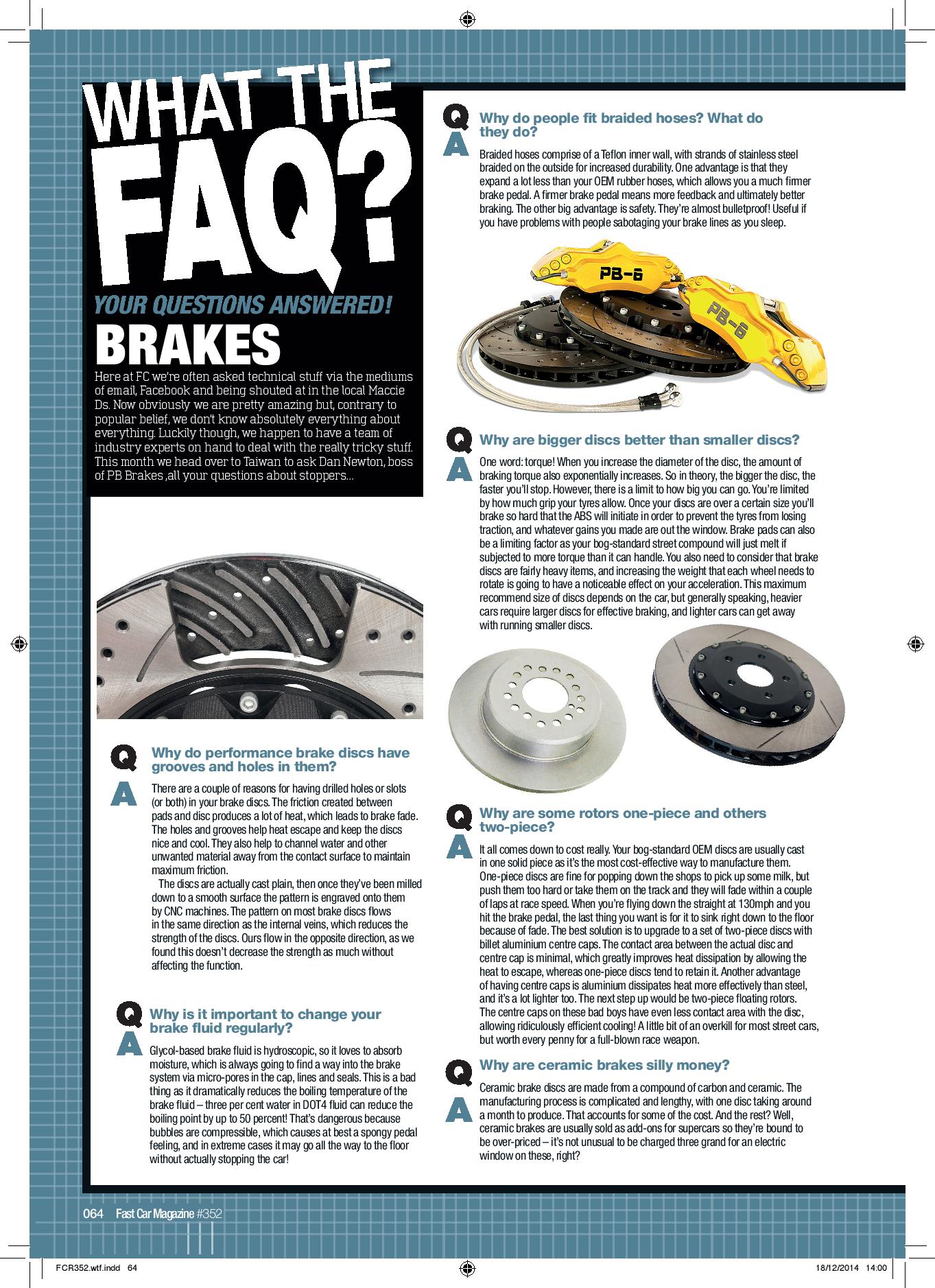
Q. Why do people fit braided hoses? What do they do?
A. Braided hoses comprise of a Teflon inner wall, with strands of stainless steel braided on the outside for increased durability. One advantage is that they expand a lot less than your OEM rubber hoses, which allows you a much firmer brake pedal. A firmer brake pedal means more feedback and ultimately better braking. The other big advantage is safety. They're almost bulletproof! Useful if you have problems with people sabotaging your brake lines as you sleep.
Q. Why are bigger discs better than smaller discs?
A. One word: torque! When you increase the diameter of the disc, the amount of braking torque also exponentially increases. So in theory, the bigger the disc, the faster you'll stop. However, there is a limit to how big you can go...
Q. Why do performance brake discs have grooves and holes in them?
A. There are a couple of reasons for having drilled holes or slots (or both) in your brake discs...
Q. Why is it important to change your brake fluid regularly?
A. Glycol-based brake fluid is hydroscopic, so it loves to absorb moisture...
Q. Why are some rotors one-piece and others two-piece?
A. It all comes down to cost really...
Q. Why are ceramic brakes silly money?
A. Ceramic brake discs are made from a compound of carbon and ceramic...

Q. What does the DOT mean in brake fluid and what should I look for?
A. DOT is a system created by the Department Of Transport in the US to grade brake fluids based on their boiling points...
Q. What are brake pads made of?
A. Brake pads can be made from a variety of different materials...
Q. My BMW has an e-brake, but can I still have a big brake conversion?
A. Up until recently, you couldn't upgrade the rear brakes on a car with an electronic handbrake without losing that function...
Q. Why are fixed calipers deemed to be better than floating calipers?
A. As standard, most cars come with floating/slider calipers that have one, or if you're lucky, two pistons in the inner side of the caliper only...
Q. Why do all cars have bigger brakes on the front than on the back even when they're rear-wheel drive?
A. The reason for that is the front of the car is usually where the oily bit goes...
Q. Can you get uprated drum brakes?
A. Not really. Drum brakes on passenger cars are pretty much obsolete these days...
Q. What's the biggest brakes I can fit on my car?
A. Well, the only real physical obstruction is the size of your wheel, but there is a sensible size limit for every vehicle...
Q. I've been told I need a spot caliper for a rear conversion. What is that?
A. Handbrakes on most vehicles still use brake shoes and drums that are integrated into the rear discs...
Q. What's a hydraulic handbrake?
A. A hydraulic handbrake replaces the conventional cable-operated unit...
Q. How do I perform the perfect handbrake turn to impress the ladies?
A. I've often pondered the same question. Ask Ken Block and let me know what he says.
FAQ OFF
What is bleeding brakes and why does it have to be done?
Over time, air will find its way into the brake system, so it needs to be released every couple of years...
