
Retro Cars - Ask The Experts
Ask The Experts: Brake Questions Answered
Retro Cars - Ask The Experts
ASK THE EXPERTS
YOUR QUESTIONS ANSWERED...
Slamming on the Anchors
This month we head over to Taiwan to ask Dan Newton, boss of PB Brakes, all your questions...
What are brake pads made of?
Brake pads can be made from a variety of different materials. Your standard street compound pads are usually a non-metallic composite of various synthetic materials. They offer great cold bite and very low noise, but the drawbacks are they lack friction and will start to fade at relatively low temperatures. At the other end of the scale you have race compounds, which are either fully metallic or ceramic in composition. They offer much higher levels of friction and are a lot less susceptible to fade, but usually need warming up to optimal temperature in order to work properly. The cold bite is poor, they munch down your discs like there's no tomorrow, can be quite noisy, and you'll be lucky to get 1000 miles out of them. Great on the track, awful on the street. A good middle-ground option is a sport compound pad. Made from semi-metallic materials, the cold bite is good, and the warm bite is even better. You may or may not get a little noise depending on the application, but it's a small price to pay for big gains in friction and reduced fade.
What does the DOT mean in brake fluid and what should I look for?
DOT is a system created by the Department Of Transport in the US to grade brake fluids based on their boiling points. DOT4 is the one you want to go for as its minimum boiling point is 230°C, more than enough for street applications. DOT5 has a higher boiling point, but it's silicone based, which isn't suitable for most braking systems.
Why do all cars have bigger brakes on the front than on the back even when they're rear wheel drive?
The reason for that is the front of the car is usually where the oily bit goes, so it's already heavier than the rear without passengers. Then combine that with the fact that the weight of the vehicle shifts to the front when you brake, and it means you need more stopping power on the front end to slow the car down effectively. This is why the brake bias on most front-engine cars is around about 70-percent front and 30-percent rear.
Can you get uprated drum brakes?
Not really. Drum brakes on passenger cars are pretty much obsolete these days, so they aren't really worth upgrading. You're best off with a disc brake conversion kit instead.
Why is it important to change your brake fluid regularly?
Glycol-based brake fluid is hydroscopic so it loves to absorb moisture, which is always going to find a way into the brake system via micro pores in the cap, lines and seals. This is a bad thing since it dramatically reduces the boiling temperature of the brake fluid - 3-percent water in DOT4 fluid can reduce the boiling point by up to 50-percent! That's dangerous because bubbles are compressible, which causes at best a spongy pedal feeling, and in extreme cases it may go all the way to the floor without actually stopping the car!
Why are bigger discs better than smaller discs?
One word - torque! When you increase the diameter of the disc, the amount of braking torque also exponentially increases. So in theory the bigger the disc, the faster you'll stop. However, there is a limit as to how big you can go. You're limited by how much grip your tyres allow, once your discs are over a certain size you'll brake so hard that the ABS will initiate in order to prevent the tyres from losing traction, and whatever gains you made are out the window. Brake pads can also be a limiting factor as your bog-standard street compound will just melt if subjected to more torque than it can handle. You also need to consider that brake discs are fairly heavy items, and increasing the weight that each wheel needs to rotate is going to have a noticeable effect on your acceleration. This maximum recommended size of discs depends on the car, but generally speaking, heavier cars require larger discs for effective braking, and lighter cars can get away with running smaller discs.

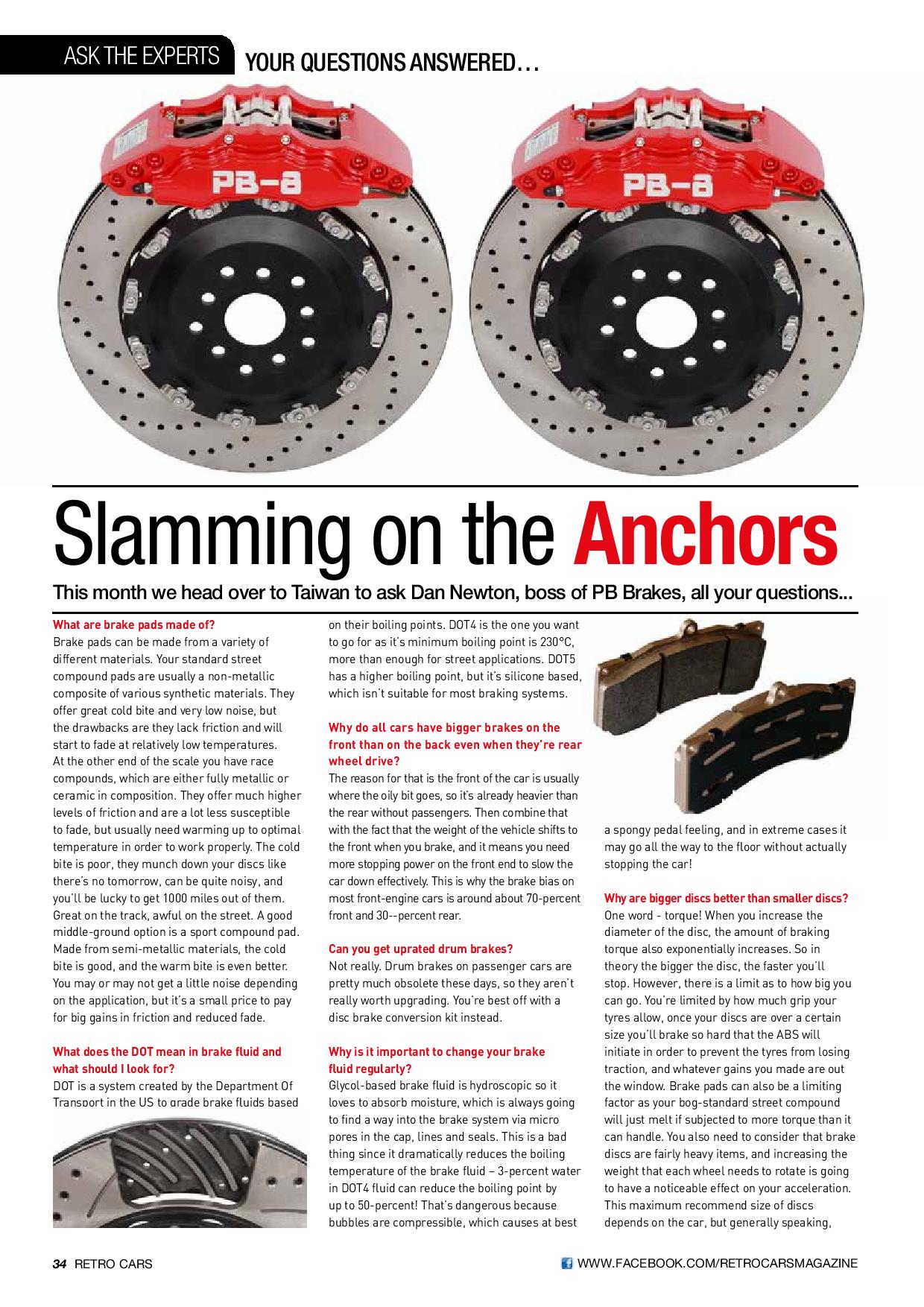
Why do performance brake discs have grooves and holes in them?
There are a couple of reasons for having drilled holes or slots (or both) in your discs. The friction created between the pads and disc produces a lot of heat, which leads to brake fade. The holes and grooves help the heat to escape and keep the discs nice and cool. They also help to channel water and other unwanted material away from the contact surface to maintain maximum friction. The discs are actually cast plain, then once they have been milled down to a smooth surface the pattern is engraved onto them by CNC machine.
Why do people fit braided hoses?
Braided hoses comprise of a Teflon inner wall, with strands of stainless steel braided on the outside for increased durability. One advantage is that they expand a lot less than your OEM rubber hoses, which allows you a much firmer brake pedal. A firmer brake pedal means more feedback and ultimately better braking. The other big advantage is safety - they're almost bulletproof!
Why are some rotors 1-piece items and others 2-piece?
It all comes down to cost really. Your bog-standard OEM discs are usually cast in one solid piece as this is the most cost-effective way to manufacture them. 1-piece discs are fine for popping down the shops to pick up some milk, but push them too hard or take them on the track and they will fade within a couple of laps at race speed. When you're flying down the straight at 130mph and you hit the brake pedal, the last thing you want is for it to sink right down to the floor because of fade. The best solution is to upgrade to a set of 2-piece discs with billet aluminium centre caps. The contact area between the actual disc and centre cap is minimal, which greatly improves dissipation by allowing the heat to escape, whereas 1-piece discs tend to retain it. Another advantage of having centre caps is aluminium dissipates heat more effectively than steel, and it's a lot lighter too. The next step up would be 2-piece floating rotors. The centre caps on these have even less contact area with the disc, allowing ridiculously efficient cooling. A little overkill for most street cars, but worth
